What is KidLit?
What is KidLit? The short answer: “KidLit” is content for children aged 0–18.
This can be in the form board books, YA novels, children’s poetry collections, short stories for kid magazines, and more. Of course, there’s a lot more to it, and if you’re writing for children there are some important details to keep in mind.
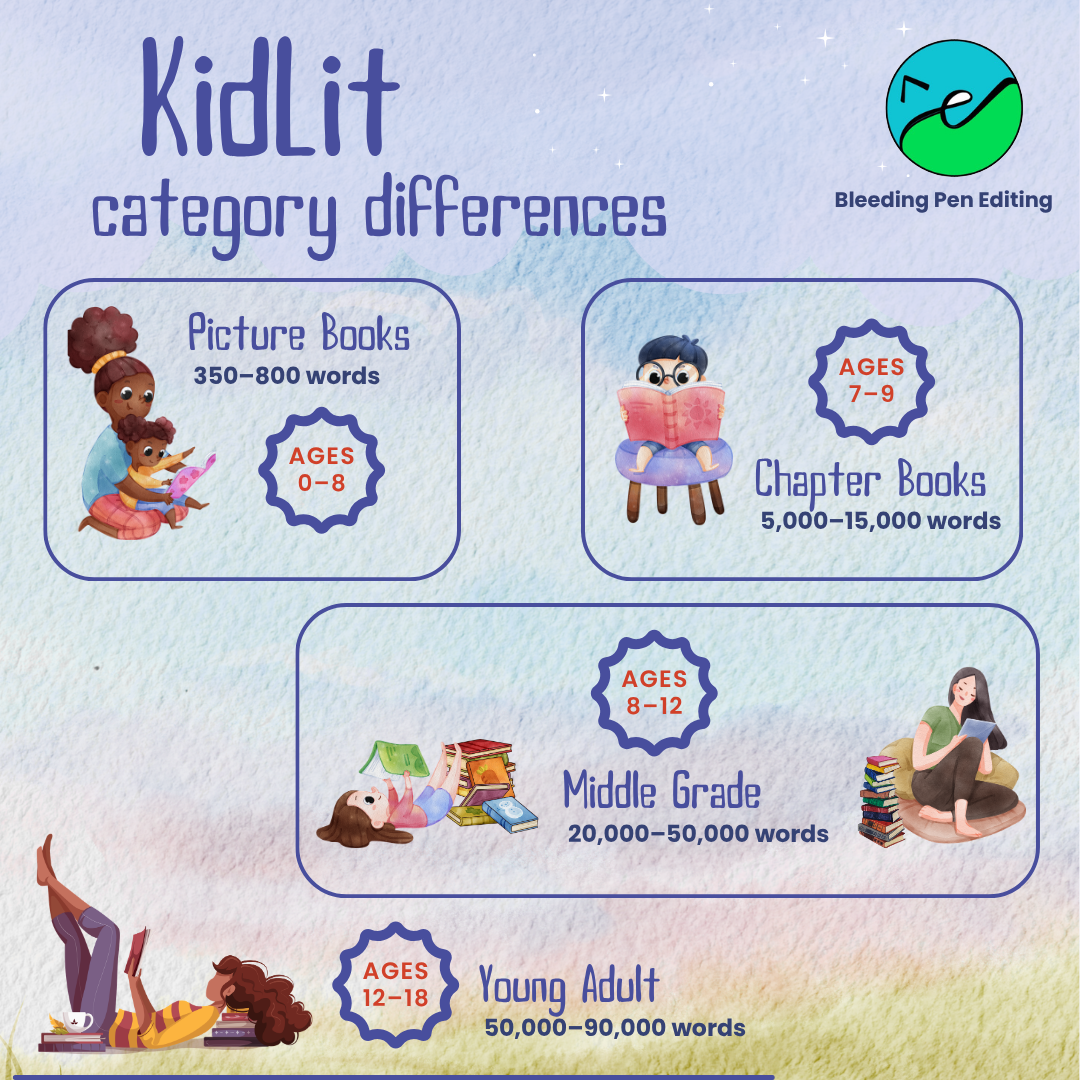
Broadly, KidLit falls into five different age-related categories:
Picture Books (0–8 years old)
Early Readers (4–8 years old)
Chapter Books (7–9 years old)
Middle Grade (8–12 years old)
Young Adult (12–18 years old)
Picture Books
Everybody knows what a picture book is (I bet you can name a few of your favorites). But what makes them so unique and hard to write?
Picture Books (PBs) are aimed at the youngest audience—kids aged 0–8. But, unlike other books for kids, they must also appeal to another audience: the person reading to the children. Usually this is an adult … think grandma who buys the book as a gift, daddy who reads to their little during bedtime, or the librarian in charge of purchasing.
Intimately tied to the audience component is another crucial aspect: PBs are designed to be read aloud. That means, they have to sound good. Whether they are lyrically written or made to elicit a belly laugh, they must be fun to read!
Which leads us to the next element: PBs have re-readability. If you’ve ever been around small children, you know they return to some books over and over and over. This is by design! PBs are a keystone of literacy. In early literacy pre-readers begin connecting letter shapes and sounds with their visual meaning (think about the letters P I N E. As a reader, you know those letters refer to a tree—and not just any tree, but a specific kind of tree). Pre-readers build literacy by connecting the images in PBs with the sounds of the story. Re-reading a text helps to form those connections.
But wait! There’s more!
PBs are SHORT. The entire story must be told in no more than 800 words (500 is the sweet spot). They are only 32–40 pages (and about 4 of those are used for publication information). That means that an entire story arc, complete with interesting characters happens very quickly! Every. Single. Word. must be carefully chosen to deliver the most impact.
Some PBs are written in rhyme. And let’s be honest: you’ve read some that just didn’t work. You’re reading along and suddenly you trip on a line because the meter was broken or the rhyme was forced. These books needed a little more polishing. But when it works well, rhyming PBs are a pleasure to read! *Stay tuned for a post specifically on rhyming in picture books.
Finally, PBs are full of … you guessed it, pictures! In a PB, half the story is told in images. But here’s the interesting thing: unless you’re also an illustrator (or planning to self-publish), you probably won’t have much say over what the images look like. Illustrators elevate the writing and sometimes weave a sub-plot into the story.
Picture Book Take-Aways
Picture books are unique!
aimed at children 0–8 years old (but at the adult reader)
designed to be read aloud
have re-readability
250–800 words
Board books are even shorter (100 words or less)
32–40 pages
rhyming PBs must have impeccable meter
½ the story is told in the images
Early Readers
Early Readers (ERs) are the stepping stone between PBs and CBs. They’re designed for emerging readers aged 4–8.
ERs are designed for readers learning to recognize some sight words and “sound out” others. They are simple texts and like PBs, rely heavily on images. ERs are truly a learning tool. The images reinforce the printed text.
Another similarity between ERs and PBs is how they’re meant to be read: aloud. But, whereas PBs are designed to be read to a child, ERs are designed to be read by a child (or novice reader). With ERs, the adult (fluent reader) is a support and helps the child (new reader) make sense of the words. Crucially, they do not have chapters!
Early Reader Take-Aways
aimed at children aged 4–8
to be read independently
designed to be read aloud
heavy reliance on images
800–2500 words
32–64 pages
no chapters
Chapter Books
Chapter Books (CBs) are designed for the newly independent reader—usually between 7–9 years old.
CBs are longer than ERs, but they remain short (typically 5,000–15,000 words or 64–120 pages). A key difference, though, is that CBs are broken into chapters—these are “big kid” books! CB chapters are usually short, allowing the reader to experience success in chunks.
Where PBs and ERs rely heavily on images, CBs are use spot illustrations to emphasize key elements of the story. They don’t rely on the images to convey meaning. Pictures may be scattered throughout a longer chapter, or are limited to the beginning of the chapter.
In a CB, the story is character driven. This means that there is a clear narrative arc and the main character proceeds through a series of obstacles to reach a concrete goal. In doing so, they experience some type of growth or change by the end of the story.
Chapter Book Take-Aways
aimed at emerging independent readers aged 7–9
5,000–15,000 words
64–120 pages
short chapters
some images
clear narrative arc
interesting main character
Middle Grade
Middle Grade (MG) books are geared for readers aged 8–12. They are slightly longer and more complex than chapter books.
Because reading levels and developmental stages vary so much in this age group, MG texts are split into two sub-categories: younger (lower) and older (upper). The younger MG reader is typically 8–10 years old, while the older MG reader is typically 10–12 years old. In both cases, the protagonist in the story is around the same age (developmentally, physically, and emotionally) as the reader.
As you might expect, MG books are longer than CBs and include fewer (if any) illustrations!Younger MG books run between 20,000–35,000 words (80–140 pages) and may include some spot illustrations. Older MG books are often a bit longer, 45,000–55,000 words (180–220 pages) and typically don’t have illustrations (save for a small glyph or spot illustration at the start of a chapter).
In terms of story, characters in MG texts are more complicated than those we find in CBs (just like the kids reading them!). There may be more than one main character and the interaction between characters helps to create tension in the story.
MG plot lines are generally told in 3rd person and show the characters reacting to events (rather than analyzing events like we see in YA). This 3rd person narrative allows the reader to experience events from a distance.
In MG texts, we start to see more elaborate world building. This generally means MG texts showcase voice, imagery, and description in the writing. These vivid descriptions allow readers to really become immersed in the story.
Middle Grade Take-Aways
aimed at independent readers aged 8–12
20,000–50,000 words
80–220 pages
younger (lower) MG
lower reading level
fewer words
larger font
some pictures
older (upper) MG
higher reading level
more words
smaller font
few (if any) pictures
more complicated characters
3rd person POV creates distance between reader and events of the story
Young Adult
Young Adult (YA) books are intended for readers between 12–18.
Because they are intended for an older (and presumably more mature) audience, things like profanity, sexuality, romance, and violence are all acceptable topics in YA. This doesn’t mean that all YA stories will include these, just that they aren’t frowned upon in this age category.
These longer texts feature a protagonist who is around 18 years old and faces complicated social conflicts that encourage deep thinking and discovery. In other words, YA novels emphasize emotional resonance. When the story is in 1st person, it provokes the reader to analyze their own place in the world.
Young Adult Take-Aways
aimed at independent readers aged 13–18
50,000–90,000 words
200–360 pages
more mature subject matter—protagonist generally 17–18 years old
compelling social conflicts
complex characters
hierarchy in character status
emotional resonance
Whether you’re a reader or a writer, understanding KidLit categories will help you identify the perfect book.